

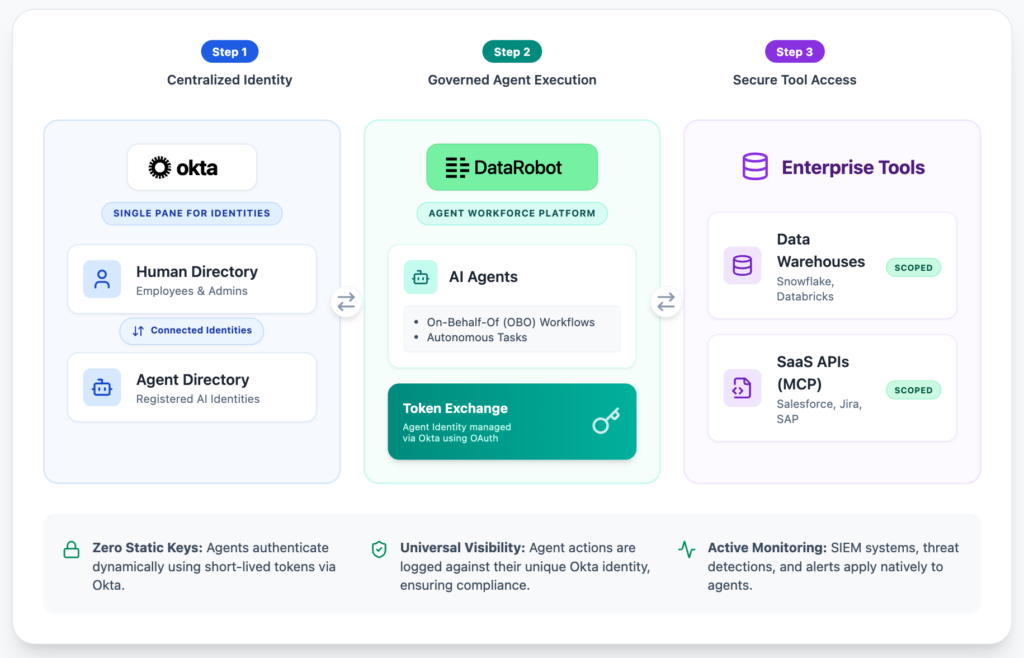
Identity-first governance treats autonomous systems as first-class identities within the same directory that governs human users. Each agent receives a distinct identity, clearly scoped permissions, and auditable activity attribution. This changes the control model. Access is tied to identity rather than static credentials. Actions are logged to a specific actor. Permissions can be adjusted without modifying code. Revocation occurs at the identity layer, not inside application logic. The result is a unified identity plane for human and autonomous actors. Instead of building parallel AI security stacks, organizations extend existing identity controls. Policy remains consistent. Incident response remains centralized. Innovation scales without fragmenting governance.
Source: www.datarobot.com