Editor-in chief. Market intelligence and strategy expert, and long-year speaker, moderator. More than 15 years in global identity verification, age verification, and RegTech markets.
Posts by Per Henrikson:

Identity verification is no longer just about passwords or a single biometric, like a fingerprint. Your team now has to account for identity factors that can be spoofed, replayed, or manipulated across voice, face, device, and behavioral channels.
As age verification laws expand worldwide, organizations face growing pressure to protect users' privacy while meeting regulatory requirements. Incode explains how on-device age estimation verifies age without transmitting or storing facial images, reducing biometric privacy risks while supporting compliance.

The identity service provider Verimi will cease its business operations at the end of 2026. It cites changed strategic framework conditions as the reason.

The combination unites Fourthline's KYC/AML compliance orchestration across Northern and Central Europe with Veridas's proprietary identity and anti-fraud stack and market position in Southern Europe, the US, and Latin America.

Operating within Socure's FedRAMP Moderate-authorized environment, the solution delivers a continuous view of identity, including real-time identity resolution, attribute validation, fraud detection, behavioral analytics, and digital intelligence, all of which are fully operational and configurable to adapt as threat actors evolve.

irms are rising to the challenge of providing robust protection across biometric modalities. Modulate, Resemble and Polygraf have all launched deepfake detection products that address specific problems across the fraud spectrum.

US senator Warner's proposed AI AGENT Act would require large online platforms to permit authorized AI agents to act on behalf of users while imposing fiduciary-style obligations and technical governance requirements on AI agent providers.

Socure’s AI-powered layered verification infrastructure claims instantly verifies more than 99% of identities with both passive and active methods, compared to an industry average of 64%.

Entrust describes the Accelerator as a “trust plane” for autonomous AI, built on verifiable identity, real-time authorization and cryptographic proof of action that can travel across systems, partners and workflows.

BOYLE Sports is using Jumio’s Identity Verification and Doc Proof solutions to automatically and rapidly verify new players’ identities during onboarding.

Canadian startup deepidv and fraud prevention developer Scam.AI will work together under a new partnership that also includes software integration.
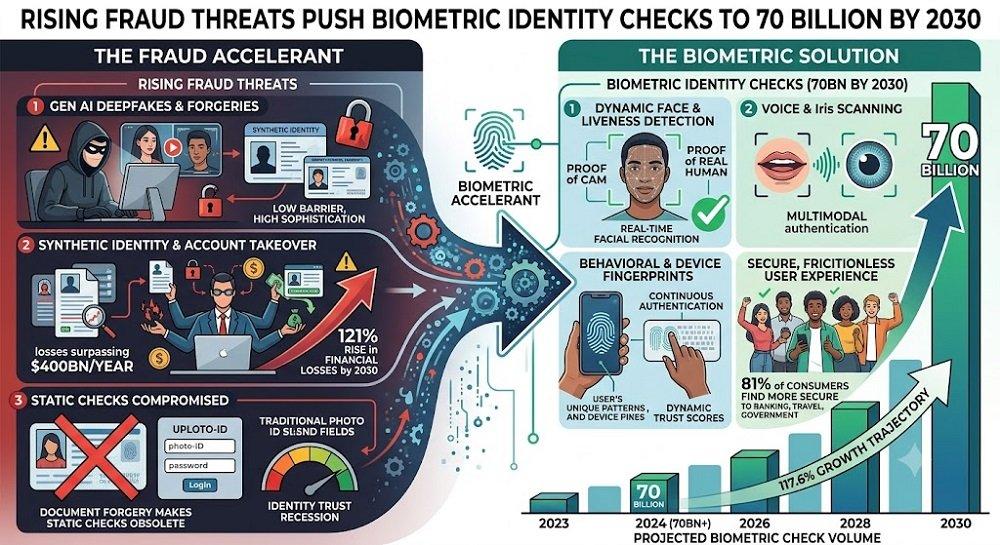
According Juniper Research, biometric verification checks are projected to rise from 32.2 billion in 2026 to 70.1 billion by 2030, representing a 117.6 per cent growth and making it the fastest-growing method of digital identity verification during the period.

