2026-07-26Ian Fleming
A hacker has come forward to detail how he weaponized free artificial intelligence to rake in approximately 1 billion yen through deepfakes.
View more
2026-07-21Ian Fleming
Scammers now deploying deepfake videos of senior FBI officials and spoofed IC3 websites to defraud previous fraud victims a second time.
View more
2026-07-20Per Henrikson
Global study reveals 64% of South African organisations already deploy autonomous AI agents with little to no governance, while 63% of employees admit they are unlikely to be able to spot attacks such as deepfakes
View more
2026-07-15Ian Fleming
Congress heard calls for continuous identity verification to counter AI fraud, alongside warnings about creating systems capable of persistent surveillance.
View more
2026-07-14Ian Fleming
Organizations across industries are confronting a sharp escalation in AI-enabled social engineering scams — highly targeted campaigns that harness AI to craft convincing text, voice and video communications, fueling attacks that have surged in both volume and sophistication.
View more
2026-07-13Per Henrikson
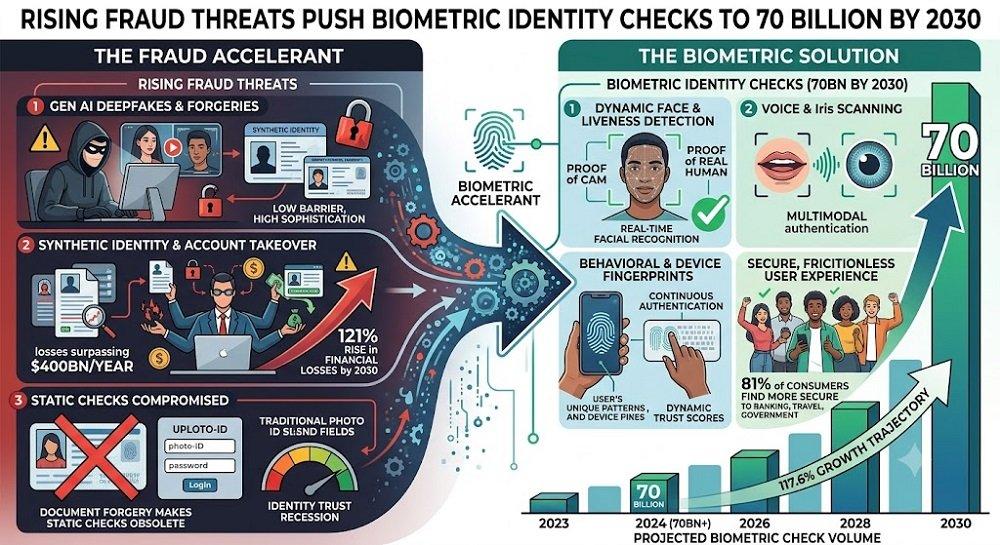
According Juniper Research, biometric verification checks are projected to rise from 32.2 billion in 2026 to 70.1 billion by 2030, representing a 117.6 per cent growth and making it the fastest-growing method of digital identity verification during the period.
View more
2026-06-30Ian Fleming
An agent behaves more like a human in that it can interpret a goal, choose a path, and act across systems. But it scales like software and processes at machine speed. It can be created quickly, embedded into SaaS products, copied by developers, delegated permissions by users, and left running long after the original need is gone.
View more
2026-06-30Ian Fleming
As AI is adopted across industries, it’s also being taken up by scammers. Around 15 million people were scammed out of money last year, according to the poll.
View more
2026-06-24Ian Fleming
The interest in deepfakes-as-a-service (DFaaS) among criminals is growing, and the cybersecurity community is worried it might fuel the next wave of “fake boss” scams.
View more
Your experience on this site will be improved by allowing cookies
Cookie Policy